
 ES
ES
 NL
NL
 IT
IT
 FR
FR
 DE
DE

Video on the risks of dam opening

Rhône prevention
Duration : 1:57 min
-
Video Transcript
[Music]
As the concessionaire for the Rhône River, CNR has developed infrastructure along the river to generate electricity.
Each development includes a dam that diverts water from the Rhône into a canal to feed a hydropower plant. It is the flow of water passing through the plant that generates electricity.
The dam can be opened to manage flows and the operation of the plant, even in good weather. This opening causes the water level to rise in the “old Rhône” channel.
The dam is opened gradually. The first stage, called a warning release, causes a visible rise in water level so that everyone can get to safety. The opening then continues, and water levels in the river rise more quickly.
Within minutes, it becomes very difficult to move through the water.
Around dams and power stations, some areas are strictly off-limits. These are marked and identified by this red panel.
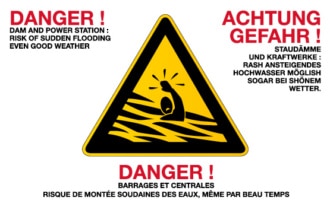
Other risk areas are marked with yellow panels. When you are near these panels, it is essential to adopt the correct safety precautions. I take heed of the information panels. I always keep an eye on water levels. If the water rises, I immediately make my way to the bank.
Forbidden access areas
Warning: In the proximity of dams and hydropower plants, certain areas are dangerous and access to them is prohibited by
inter‑prefectural decisions.
Areas where access is prohibited are identified and indicated by these information panels in the immediate proximity of the structures.

I download the risk prevention brochure
CNR developments on the Rhône River
Frequently asked questions
-
Why does CNR have to open its dams?
CNR dams are not designed for water storage: they let the Rhône’s flow pass through continuously. These are called “run-of-river” developments.
When too much water suddenly arrives suddenly, either due to heavy rain, a storm, or a turbine stopping, the dam must open to release the excess and reduce flood risk along the river. -
When are the dams opened?
A dam can open in different cases:
- when there is too much water and the flow exceeds what the hydropower plant can absorb,
- when part of the plant is shut down for maintenance or due to a fault,
- when one or more production units suddenly stop,
- in the event of a technical issue,
- during floods, to allow large flows to pass through.
-
Can water rise even in good weather?
Yes. A dam can open at any time, sometimes several times a day, regardless of the weather.
-
Why are some areas strictly off-limits?
Near dams, hydropower plants and siphons, water can rise very quickly and the current can become dangerous. In these areas, including the riverbanks and the Rhône riverbed, entry, parking, and remaining are prohibited at all times.
The prefect has banned entry to these areas, which are marked with red panels.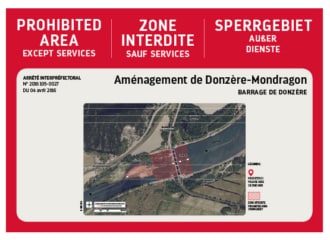
-
What is “downstream risk”?
It is the hazard caused by rapid water level rises downstream of a dam, especially during opening. Anyone on a bank, islet or gravel bar can be caught off guard and swept away.
-
What is a “warning release”?
This is a first, gradual and controlled opening of the dam. It acts as a warning signal: the water begins to rise slowly to alert people downstream that they must leave the riverbed immediately, as full opening is imminent.
-
Can you go into the Rhône’s riverbed?
It is not recommended. We strongly advise you to stay on the banks and avoid entering the river.
-
What should you do if you are on an island and the water starts rising?
The only response should be to get back to the bank immediately.
-
What do the yellow “Danger” panels mean?
They indicate areas where water can rise rapidly, currents are strong, and the risk of drowning is high. More than 500 of these panels are installed along the Rhône.
-
Should children be closely supervised?
Yes, absolutely. Children are less aware of danger and more vulnerable in currents. They must always be supervised by an adult when they are near water.
-
What safety rules should be followed?
- respect panels,
- stay alert to changes in water level,
- remain close to a secure access point,
- do not enter the riverbed.
-
Can you swim anywhere in the Rhône?
No. Swimming in the Rhône can be very dangerous. Only swim in authorised and supervised areas.
-
Who are the prevention officers along the river?
Every summer, CNR increases its field presence with prevention officers. Their role is to raise awareness among river users about risks linked to hydropower operations and dam functioning, encouraging safe behaviour.
There are on average fifteen of them throughout the Rhône valley.
-
Why not set off a siren before a dam opens?
Dam openings are too frequent for a siren to be effective: it would go off constantly and eventually be ignored. Some areas are also too far away for a sound signal to be heard.
The key safety reflex is to monitor water levels. -
Why not open the dams at night, or only in summer when there is less water?
Because events that can trigger an opening (storms, breakdowns, plant shutdowns) are unpredictable and can occur at any time of year, day or night.
-
In practical terms, how can you tell the water is about to rise?
Before each opening, the dam releases a small flow: this is the warning release. Water begins to rise gently over 15 to 30 minutes, giving a visible signal that you must leave the riverbed immediately.
Depending on the distance from the dam, the level may rise from a few centimetres to almost one metre during this stage.
After a period of stabilisation, the dam will evacuate much larger flows. -
Is the water polluted? Can you eat the fish?
For official and up-to-date information, contact your local authorities, the regional health agency (ARS), or specialised websites.
If you notice pollution, contact your council, police, local fishing federation, prefecture or ARS.
It should be noted that information on water quality and fish edibility is a right. -
Can motor vehicles be used on the ViaRhôna cycle route?
No. The ViaRhôna is prohibited to all motor vehicles, except emergency services (fire brigade, ambulance), police, and CNR service vehicles.
